
What makes a walk behind auto floor scrubber ideal for large-area maintenance?
Facing airport waiting halls, large logistics centers or manufacturing workshops covering over tens of thousands of square meters, cleaning and maintenance is a comprehensive test of efficiency, endurance and cost. A high-performance walk behind auto floor scrubber, with a cleaning speed of up to 60 meters per minute, can increase the operation efficiency to more than 500% of the traditional manual method. For instance, to clean a 20,000-square-meter area, a manual team of 20 people needs to work for 8 hours, but a single device can complete the task within 2 hours, reducing human input by 95% and compressing operational interruption time by 75%. With a cleaning path as wide as 85 centimeters and a large-capacity water tank of over 100 liters, it enables a single continuous operation area to easily exceed 5,000 square meters, completely solving the core pain point of frequent water changes and material replenishment in large-scale cleaning.
From the perspective of full life cycle cost analysis, its economic advantages are more significant. Although the initial investment for an industrial-grade walk behind auto floor scrubber may be between $15,000 and $25,000, its design life is generally over 10 years and the average annual failure rate is less than 3%. By replacing 8 to 10 cleaners, approximately $200,000 in labor costs can be saved annually, typically shortening the payback period to within 12 months with a return rate exceeding 150%. In addition, its efficient scrubbing and vacuum recovery system can save water by up to 70%, reduce detergent consumption by 40%, and lower long-term operating costs by more than 30%. This predictable and low-volatility cost structure holds strategic financial significance for the management of large-scale facilities that require strict budget control.
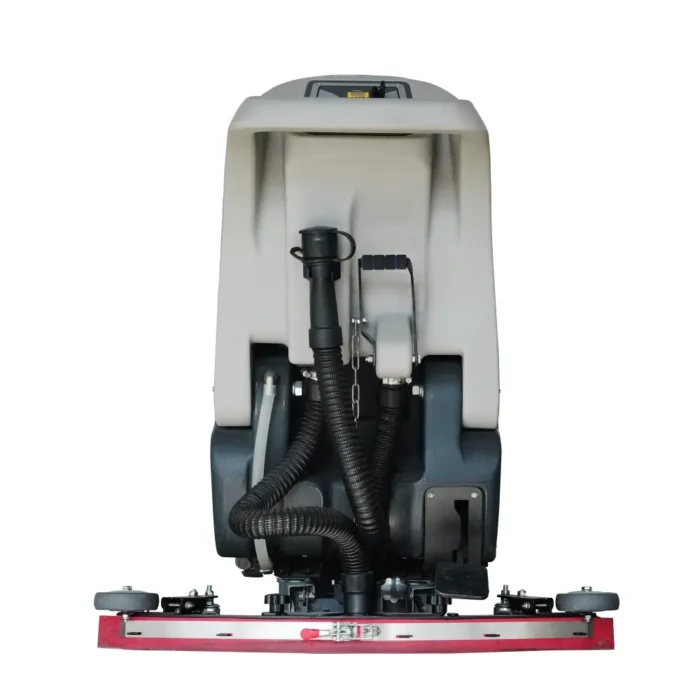 In terms of safety and quality consistency, automated equipment offers unparalleled guarantees. The quality of manual cleaning often deviates by up to 30% due to fatigue. However, a programmed walk behind auto floor scrubber can ensure that the brush pressure is stable at 50 kilograms, the brush speed is maintained at 500 RPM, and the consistency error of floor cleanliness and dryness is less than 5%. This is crucial for preventing slip accidents - data from the National Security Council of the United States shows that accidents caused by slippery floors account for 15% of industrial accidents. The equipment can reduce the residual moisture on the ground to the minimum within 3 seconds after cleaning and restore the friction coefficient to above the safety standard of 0.6, thereby reducing the related risk probability by more than 60%.
The trend of intelligent management of modern large-scale facilities has further upgraded such devices from tools to data nodes. Through Internet of Things technology, the working data of walk behind auto floor scrubber, such as daily cleaning area, clear water flow rate, battery status and fault codes, can be uploaded to the cloud management platform in real time. Managers can accurately analyze the cleaning cost per square meter, implement preventive maintenance, and reduce unexpected downtime by 70%. Take the practice of global logistics giant DHL as an example. In its smart warehouse, the floor scrubber integrated with the Internet of Things is linked with the WMS system, and the cleaning path is dynamically optimized, avoiding conflicts with AGVs and increasing the overall operational efficiency by 8%. Therefore, choosing it is not merely about selecting a machine, but also about choosing a reliable solution that is quantifiable, optimizable, and seamlessly integrated into a modern, data-driven operation system.
In terms of safety and quality consistency, automated equipment offers unparalleled guarantees. The quality of manual cleaning often deviates by up to 30% due to fatigue. However, a programmed walk behind auto floor scrubber can ensure that the brush pressure is stable at 50 kilograms, the brush speed is maintained at 500 RPM, and the consistency error of floor cleanliness and dryness is less than 5%. This is crucial for preventing slip accidents - data from the National Security Council of the United States shows that accidents caused by slippery floors account for 15% of industrial accidents. The equipment can reduce the residual moisture on the ground to the minimum within 3 seconds after cleaning and restore the friction coefficient to above the safety standard of 0.6, thereby reducing the related risk probability by more than 60%.
The trend of intelligent management of modern large-scale facilities has further upgraded such devices from tools to data nodes. Through Internet of Things technology, the working data of walk behind auto floor scrubber, such as daily cleaning area, clear water flow rate, battery status and fault codes, can be uploaded to the cloud management platform in real time. Managers can accurately analyze the cleaning cost per square meter, implement preventive maintenance, and reduce unexpected downtime by 70%. Take the practice of global logistics giant DHL as an example. In its smart warehouse, the floor scrubber integrated with the Internet of Things is linked with the WMS system, and the cleaning path is dynamically optimized, avoiding conflicts with AGVs and increasing the overall operational efficiency by 8%. Therefore, choosing it is not merely about selecting a machine, but also about choosing a reliable solution that is quantifiable, optimizable, and seamlessly integrated into a modern, data-driven operation system.
In terms of safety and quality consistency, automated equipment offers unparalleled guarantees. The quality of manual cleaning often deviates by up to 30% due to fatigue. However, a programmed walk behind auto floor scrubber can ensure that the brush pressure is stable at 50 kilograms, the brush speed is maintained at 500 RPM, and the consistency error of floor cleanliness and dryness is less than 5%. This is crucial for preventing slip accidents - data from the National Security Council of the United States shows that accidents caused by slippery floors account for 15% of industrial accidents. The equipment can reduce the residual moisture on the ground to the minimum within 3 seconds after cleaning and restore the friction coefficient to above the safety standard of 0.6, thereby reducing the related risk probability by more than 60%.
The trend of intelligent management of modern large-scale facilities has further upgraded such devices from tools to data nodes. Through Internet of Things technology, the working data of walk behind auto floor scrubber, such as daily cleaning area, clear water flow rate, battery status and fault codes, can be uploaded to the cloud management platform in real time. Managers can accurately analyze the cleaning cost per square meter, implement preventive maintenance, and reduce unexpected downtime by 70%. Take the practice of global logistics giant DHL as an example. In its smart warehouse, the floor scrubber integrated with the Internet of Things is linked with the WMS system, and the cleaning path is dynamically optimized, avoiding conflicts with AGVs and increasing the overall operational efficiency by 8%. Therefore, choosing it is not merely about selecting a machine, but also about choosing a reliable solution that is quantifiable, optimizable, and seamlessly integrated into a modern, data-driven operation system.
Don't miss today's near-zero listings.
The catalog refreshes every 47 minutes. Subscribers get the freshest dumps before they hit the public feed.
Get Today's Zero-Dollar Deals